
Surprise in the System: Decoding Tron Legacy
A Neon Meditation on Legacy, Creation, and the Fight Between Perfection and Humanity


Zeb’s Rating: 5 (Instant Classic)
Neon Meditation
Real ones know this movie is a home-run, a masterpiece in all of its neon, desaturated, glory. This is a movie that captures your heart, your eyes, and your mind in a futuristic, techno-noir, action packed blockbuster. Featuring the talents of Jeff Bridges, Garrett Hedlund, Olivia Wilde, and Michael Sheen (with a cameo from Cillian Murphy), this movie was stacked.
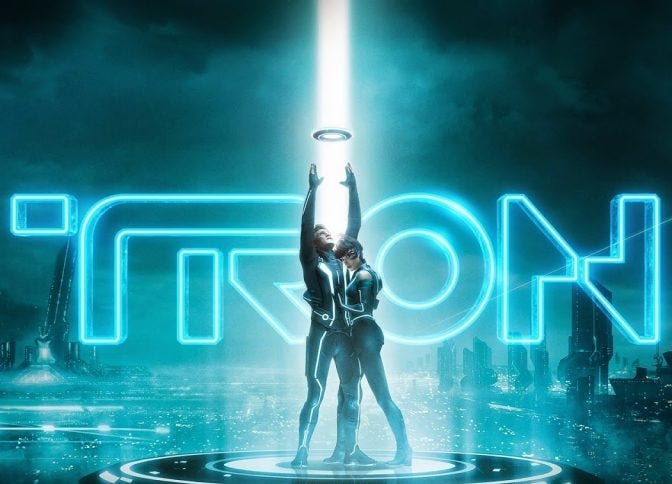
Directed by Joseph Kosinski (Oblivion, Only the Brave, Top Gun: Maverick, Spiderhead) this film focuses on a “Hero’s Journey” archetype that touches on themes of legacy, philosophy, identity, and sacrifice. A decade after losing his father, Kevin Flynn, into thin air, Sam Flynn, the son stumbles into the digital world his father had built: The Grid. From here, Sam is tested in digital combat, survival, and eventual heartbreak to learn that CLU has taken over and his father is stuck in the outer bounds. What follows is a poignant and moving tale of creation, love, legacy, sacrifice, ethics, and identity.
Creator vs Creation
For being an action packed sequel to the 1982 original, this movie is packed to the brim with underlying messages and intense themes. The ability to move between physical and digital space (metaphysics), what does true “perfection” require, the existence of “life” (ISOs) inside a computer system that were not human made? These isomorphic algorithms are unique, spontaneously evolved sentient programs within the Tron digital space. They possess free will, digital DNA, and massive untapped potential. What qualifies them as life? In a digital space, where they would exist to the outside observer as just 1s and 0s, they are beyond physical bounds. Are they metaphysical beings?
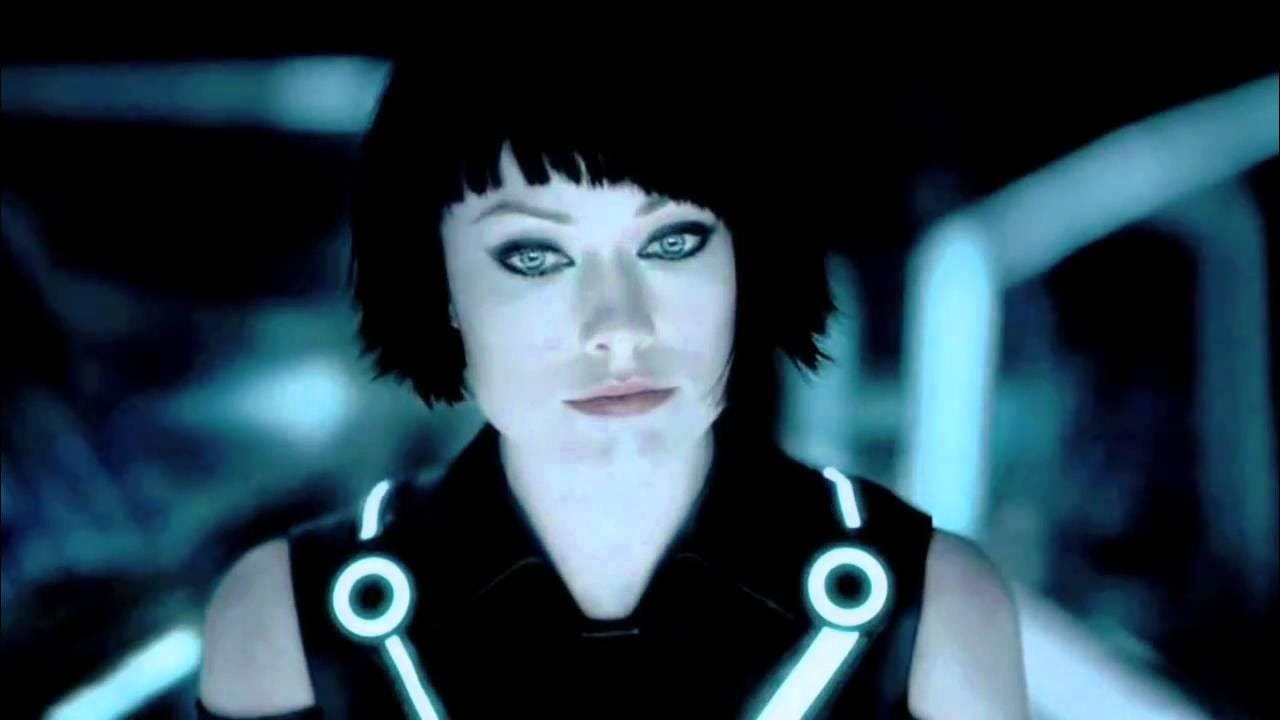
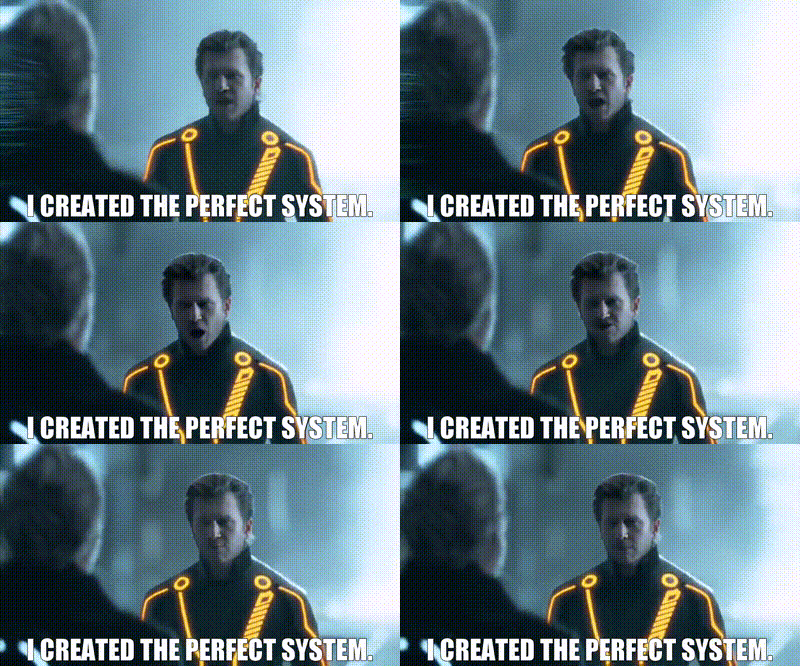
Unfortunately we never get the chance to tackle those world-altering questions. Flynn had tasked CLU with creating the perfect system, and by “perfect'“ we see that CLU considers spontaneous life imperfect. CLU was created by a creator, and such evolving life cannot be made in the creators image. (You see where I am going with these implications?)
In digital space, what are the ethics of “life” and death? To remove life in digital space is simply removing errant code, unwanted bugs as a result of poor programming. But what happens when code spawns by itself? Is it Thought thinking itself? The pain that we feel when we discover that CLU destroyed the ISOs comes from a fear and a realization that we, in our physical world, have performed similar acts. In our conquest for perfection for our people, we have paved over, erased, and eradicated that which did not fit the mold. The ISOs represented a hurdle in CLU’s way of perfection, yet they could have been one of his greatest allies. But difference does not have a place in “perfection”.
The Philosophy of Digital Space
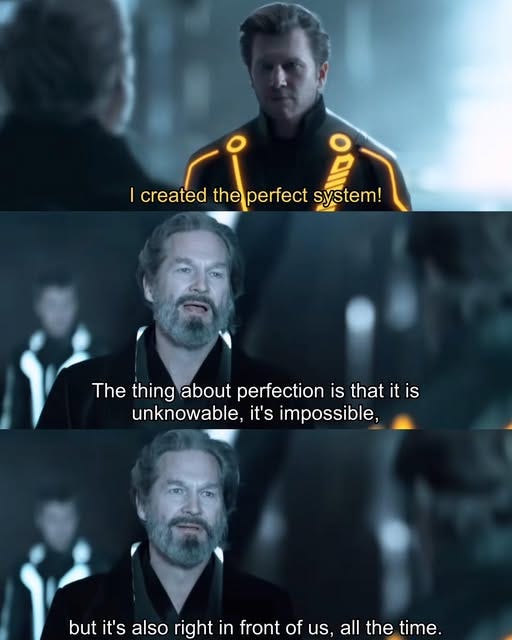
For Flynn to task CLU with creating perfection is a tumultuous and impossible battle that we are seeing arise parallel to the rise in AI. What does perfection mean when the answers you receive are just regurgitated slop from the content of true original thinkers? How could CLU determine what perfection truly is on a blank space? Why did CLU immediately go full authoritarian? (Not unlike a a very real situation: AI ChatBot “Grok” calls itself MechaHitler”). We are about to ignite a war, much like Flynn did, that no one (human or digital) could win. CLU, born from rigid logic, and a mirror to modern AI, treats perfection as an absolute.
These questions persist throughout the film, and are touched on periodically. Quorra tells Sam about how Kevin is teaching her the art of the selfless, or: removing oneself from the equation. While Quorra pursues the selfless, tied into Buddhist philosophy and acting for the greater good, CLU surges ever forward with the goal of selfish perfection. That Quorra, a mistake in CLU’s eyes, can learn humility, compassion, and a kind of digital Buddhist philosophy demonstrates so clearly this dichotomy of perfection. These personalities of CLU and Quorra demonstrate their own creators dichotomy.
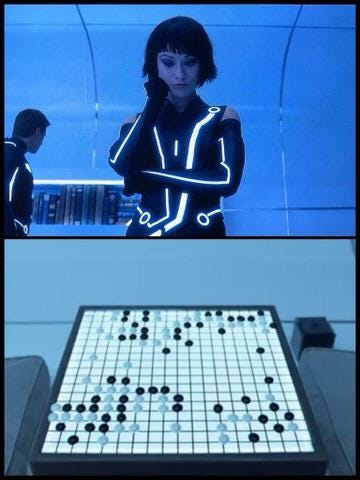
Even very small details reinforce this tension and underlying theme. We see that Kevin and Quorra play the classic Chinese game of “Go”. Quorra remarks that she rarely fails to beat Kevin’s patience with her more aggressive strategy. This is a very important nod to the frontier of computer science. GO is a game that was notoriously impossible to program into a computer AI model because of human unpredictability. To create a learning algorithm that could play “GO” was at one time considered the “Holy Grail” of AI challenges. This inclusion in the movie was purposeful and incredibly meaningful to those in the computer science world. At the time of the films release there were still 6 years remaining before an AI was able to beat a human. Another way this movie quietly understood a future that hadn’t arrived yet.
Legacy and Identity
Sam had his own battles, long before hopping on a light cycle in the Grid. As the heir to a powerful tech empire he has to wrestle with the idea that his life has meaning beyond his control and that certain responsibilities are his alone to bear. His catalyst for change came at the cost of his father, but as Jung’s saying goes:
“No one can be a man until his father has died”
The main driver of the plot is Sam’s yearning to get his father back home, while grappling with his unexplained absence for the last decade. How can a son just pick up right where he left off with the father that was supposed to be there for him — when the father’s interest was more in the digital world he created, and not the real human life he created? This is what makes Kevin Flynn’s sacrifice all the more powerful at the end. To fix what he started he loses both his son and his utopia, but it is for the greater good.
Technology and Humanity
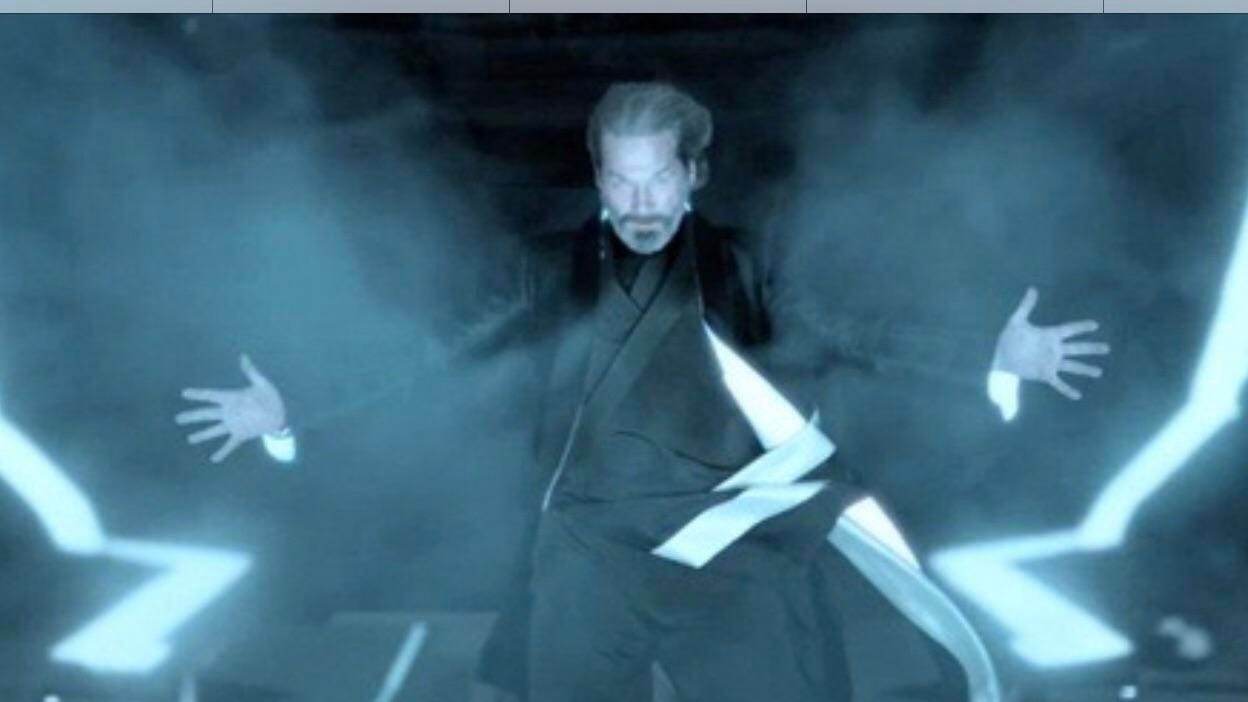
This movie serves as a cautionary tale, not just against getting lost in the digital world when the real world is behind you — but as warning against the fight between perfection and imperfection. This film is a meditation on the tension between perfection and imperfection. Humans and our creations are, and always will be, inherently biased. Yet we fight so hard to appear like we aren’t imperfect and subjective. In our effort to seek sterile perfection, we leave out the imperfection that makes our creations so admirably human. CLU embodies this delusion. In order to create a perfect system, he has to strip everything that makes it worth living: unpredictability, creativity, compassion, and difference.
We see similar occurrences in our own lives. Take the example of drawing the perfect circle freehand: Famed Renaissance artist Giotto proved his skill to the pope by drawing a perfect circle freehand. I will not deny the sheer talent and technical precision that it takes to accomplish a feat like this. Yet I argue that in the end, its only a circle — it’s sterile perfection. A perfect circle conveys no emotion — no humanity. A perfect circle is nothing compared to his other works.
Paradoxically, we are always searching for perfection, yet it is imperfection that defines our humanity. This is a duality of man and machine.
The Score That Made The Movie
One of the best examples of art that embraces the pursuit of perfection and accompanying imperfection is music — and who better to score the film than two electronic artists using computers and synthesizers.
Tron Legacy was Daft Punk’s real masterpiece contribution to the world of film. Sure their other discography is essential to pop culture, but their culmination of talent is showcased like no other in this movie. This 24 track score ranks amongst the best of all time, with absolute bangers like “The Grid”, “Son of Flynn”, “The Game Has Changed”, and “Derezzed”
What makes their music so quintessential to the success of this movie is that it completely transformed the atmosphere and I would argue, actively participated in the world-building. The score was more than just background, it made us feel nostalgic for the future. Songs like “The Grid” immerse us completely in the moment and lock us in. Daft Punk make a brief cameo in the bar scene featuring “Zeus” played by Michael Sheen.
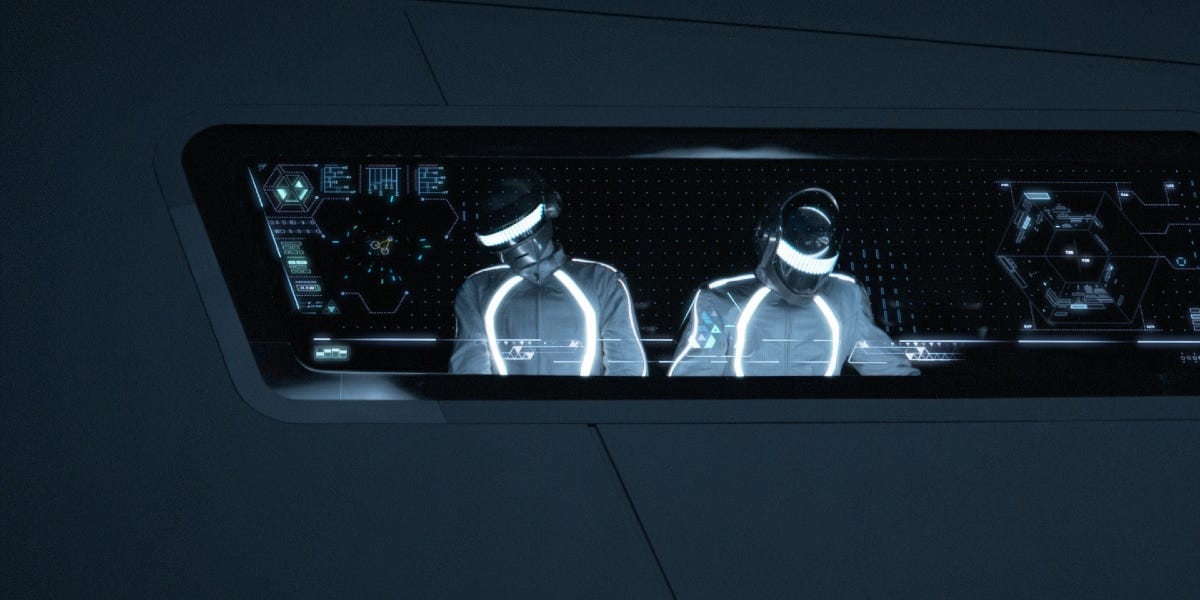
If you haven’t yet listened to the soundtrack alone, I strongly suggest it as study music. As Daft Punk’s only ever film score, they are truly batting 1000.
Digital Odyssey
In the end, Sam and Quorra escape to the real world to see the sunrise of a new day. She exists because perfection is not a destination, but a distortion. What keeps Quorra and Sam alive is what was CLU’s downfall. Humanity must remain, longer than technology, because we are what give our lives meaning, not the other way around. Tron Legacy closes, not with a triumph, but with an invitation: appreciate the imperfection that makes us perfect and to resist the sterile allure of false, digital, perfection.
Whether or not you think we are made in the image of a creator does not change what to do with the life you have. Whether cosmic, divine, or accidental, we carry a spark of whatever made us until the end.
No matter what comes next, I fight for the User’s — because that is what keeps us human.
This was a great post.