


Zeb’s Rating: 5/5 (A must read for fans of Wild West horror)
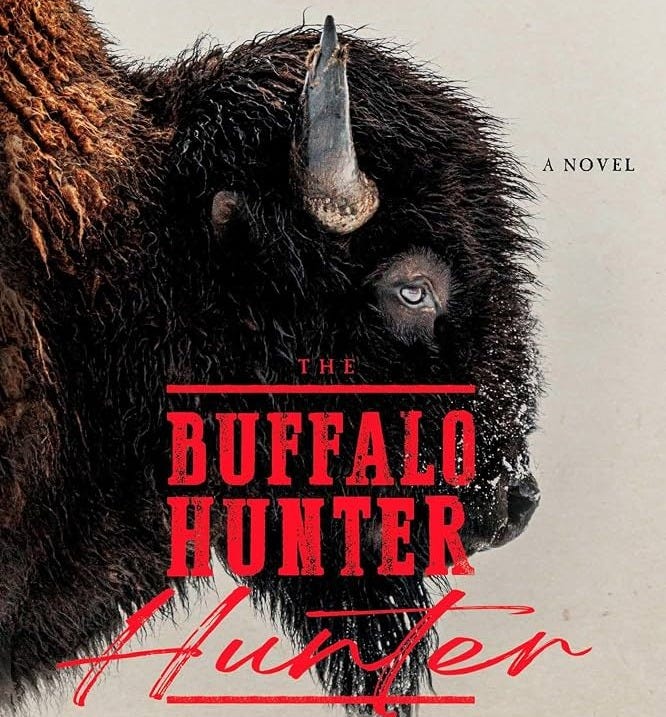
The Buffalo Hunter Hunter by Stephen Graham Jones is an astounding work that combines profound elements of the wild west (circa 1900s) with elements of thriller and horror. From here on out — SPOILERS. Should you happen to be a fan of vampires and western gothic horror, please go read this novel then return to this review.
One aspect of the novel deserves mentioning before diving into the story: please know that Stephen Graham Jones is a member of the Blackfeet Tribe of the Blackfeet Indian Reservation of Montana. This point will return as an important one.

The Plot
Jones wastes no time on establishing the mystery. We are immediately thrown into the life of an academic woman, chasing the ghosts of her past — namely her father and then her mysterious great-great-great grandfather Arthur Beaucarne.
This dive into the past of Arthur Beaucarne stems from the retrieval of a centuries old manuscript found in a demolition site in Miles City, Montana. Etsy, as we later learn her name, is entranced by the story told in this journal, although the journal reads more like a confession.
What unfolds is the story of Lutheran pastor Arthur Beaucarne as he details life in 1912 Miles City, Montana. The story centers on the discovery of “humps”—men skinned alive, faces distinctly painted, and left naked out on the plains. At the same time Arthur is visited by a strange guest, a Native man wearing a long black Jesuit-style robe and dark sunglasses.
Good Stab, as he is called, comes to Arthur (whom he calls “Three Persons” out of association with the Holy Trinity) to confess his sins and recount the story of his life.
Since this is a Lutheran pastor those of us Catholics don’t have to worry that Arthur wrote down every lucid detail of Good Stab’s story—which would break the seal of confession. [Not a relevant plot point, just my humorous musings.]
Where Stephen Graham Jones hooks us, line and sinker, is through the exquisite attention to detail of Blackfeet life. Jones makes the reader feel as though they are riding across the plains alongside the Blackfeet with each passing line of text. The raw authenticity ties our hearts directly to the woes of Good Stab.
That is until the confession shifts from the story of a life lived... to actual sins.
Upon Chief Mountain in 1870, Good Stab encounters a pale-skinned man with large fangs—the Cat Man. After being mortally wounded during a soldier attack, the Cat Man’s blood drips into Good Stab’s mouth, transforming him into a vampire. He can only consume blood, and to remain human he must feed upon humans.
After learning of the Marias Massacre, Good Stab embarks on a path of utter vengeance.
The Twist
As Good Stab returns week after week, Arthur begins to recognize a common thread pulling all too close to his own past.
Here Stephen Graham Jones springs the trap he has been quietly building all along. Up until this point we assumed we were reading a normal horror novel.
Oh no... there was much more in store.
In Arthur’s younger life he was a soldier who helped in the wars against the Native Americans in Montana.
We stop feeling sorry the moment Arthur confesses to Good Stab that it was he who encouraged the soldiers to kill all the Blackfeet at their camp next to the Marias River.
We learn there was no coincidence Good Stab chose Arthur for his confession—nor that the family from California was murdered, as they were Arthur’s illegitimate descendants.
Arthur, knowing that his end must also be near, finishes the journal and hides it deep in the parsonage before beginning his long walk into the prairie where he hopes Good Stab will finish what he started.
But such men who perpetuate violence are not worthy of such easy deaths...
The Resolution
Cut back to the present day where Etsy finishes reading the journal. A mysterious figure wearing a real buffalo head appears in her apartment and presents her with a human-sized prairie dog before “mistakenly” leaving behind a pair of workmen’s gloves.
Etsy, longing to finally end this 200-year cycle, determines to kill her great-great-great grandfather. From her apartment in Wyoming she drives north to the Marias Valley on the 173rd anniversary of the massacre and kills Arthur Beaucarne once and for all.
Down in the valley, Etsy notices one rider on horseback wearing sunglasses, with a construction hard hat attached to the saddle.
All along Good Stab had searched for the journal and was the one who unearthed it from the construction site.
Etsy waves alone, the signal not returned. Good Stab’s refusal to return her gesture of solidarity at the end reinforces that her actions do not erase the historical atrocity—they only resolve her own relationship to her ancestor.
What Makes This Book So Good
The language used throughout completely immerses the reader such that we feel as though we are there in the dusty church next to Arthur and Good Stab on the plains of Miles City Montana. The inclusion of so many Blackfeet actions, phrases, and words adds an unmistakable authenticity to the story.
This book subverts several distinct tropes in Gothic Westerns which add to the raw feeling that comes across the page. In certain works, one might expect a clean resolution, happy or not. But in this book there is no resolution. There can never be a satisfying resolution after a massacre of this scale.
We spend the majority of the plot cheering on Good Stab in taking revenge — yet like all revenge no matter how successful, it does not right the wrong. Good Stab’s tribe, his family, friends, and his buffalo are still dead. Good Stab himself will never be whole again, nor will he ever be able to die and visit his wife and kids in the sunny plains of the afterlife. The actions of one man, and those who listened, echoed across 200 years until they reached the doorstep of a woman who had no ties at all.
Here Stephen Graham Jones reminds us of the history of the settling of the west. Through the lens of a Blackfeet vampire we are first hand witnesses to the true cost of Manifest Destiny. The use of a vampire in this period of time is brilliantly original because Jones redefines what a vampire is and what it symbolizes. Vampires live by consuming others. The same can be said for the machinery of westward expansion. The natives, the buffalo, and the soul of the land that was so sacred to its original caretakers are all consumed in the name of progress and conquest. Much like a vampire, history and trauma feed on themselves. Good Stab is a reckoning to this cycle.
History does not end because the perpetrators die. Good Stab leaves Arthur in Etsy’s hands, and she does the “right” thing by finally killing him. Yet, at that final moment on the ridge above the commemoration of the massacre, Good Stab rides away without acknowledging her — because justice and reconciliation are two very distinct things.